We make a living by what we get, we make a life by what we give – Winston Churchill
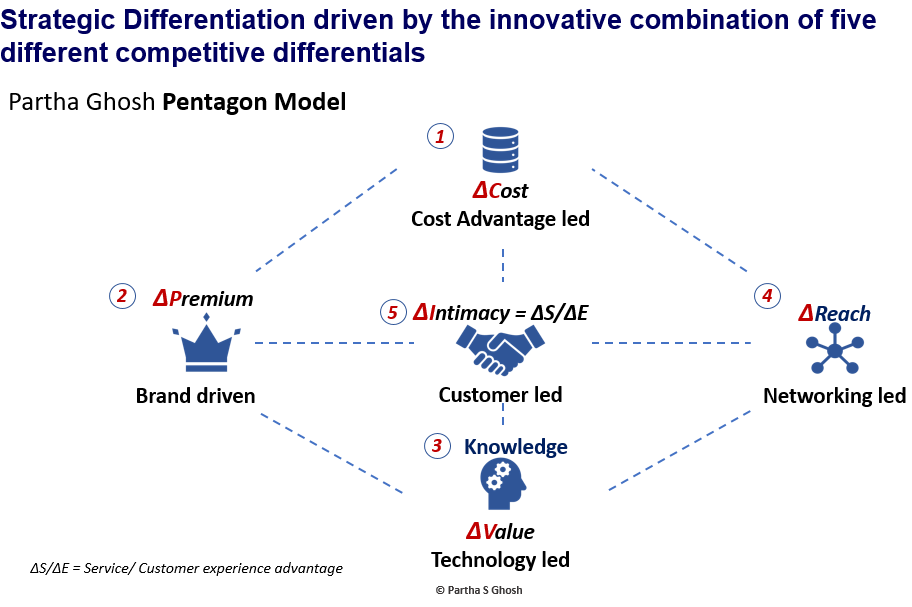
Strategic Edge = Pentagon Model
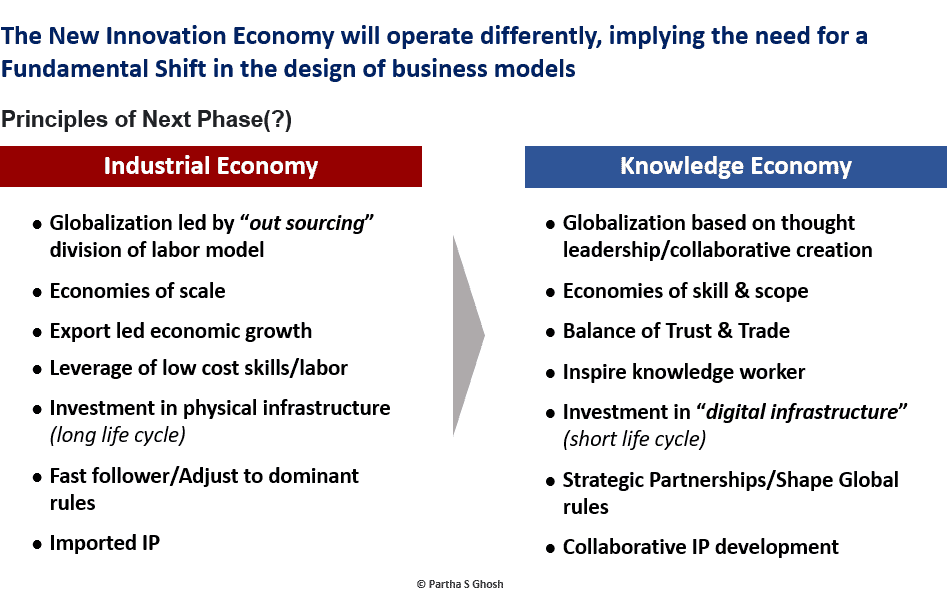
Furthermore as the global economic system transitions from industrial to knowledge economy (Exhibit below), companies which developed their competitive might (to secure significant competitive advantage) by perfecting the essential tenets of the industrial economy, will now be required to embrace a new set of principles that will define their success in the new economy. Indeed, marginal economic value of “more and better” of the formula of the past two decades will be significantly diminished. Accordingly forward looking companies will need to re-evaluate the rules of engagement with the global marketplace with a broader and deeper strategic perspective.
Transition Requirements from Industrial to Knowledge Economy
Depending upon the sectors, companies will be required to orchestrate a wider range of strategic levers to shape their competitive advantage along the life cycle of a business model. Exhibit below presents the “strategic pentagon model” which lays out how in the future companies in securing competitive gains, instead of just relying on one or two competitive advantage(s) – say cost advantage and/or network advantage, should consider examining ways to differentiate their competitive positioning based on mix of different differentials such as knowledge/technology advantage, brand (goodwill and trust) advantage, network (ecosystem to secure global reach) advantage, and/or “customer intimacy” advantage (particularly for B2B space) as competitive environment.
“Pentagon Model” for Securing Global Competitive Advantage
Accordingly, for a multi business organizations, business model strategies must be integrative across product/service lines, yet distinctly customized to local communities both in the domestic and international environments.
1. Pentagon Model is developed by Partha S Ghosh to help companies explore strategic paths by dynamically orchestrating different competitive levers to secure differentiated position in the Global economy
The ultimate resource in economic development is people.It is people, not capital or raw materials that develop an economy. – Peter Drucker
China and The World
Shaping the 21st Global Socio-Economic Landscape: Unlocking the Leader in YOU
As young minds prepare to step out into the working world, you must realize that in view of the multidimensional changes we are in the middle of, something deeper has changed and something fundamental to our very well being has been fractured. The backdrop is indeed clouded with uncertainties. There are as many views on how such issues will need to be addressed, as there are skeptics who have lost total faith in today’s institutions to provide the right kind of solutions, today’s civilization requires.
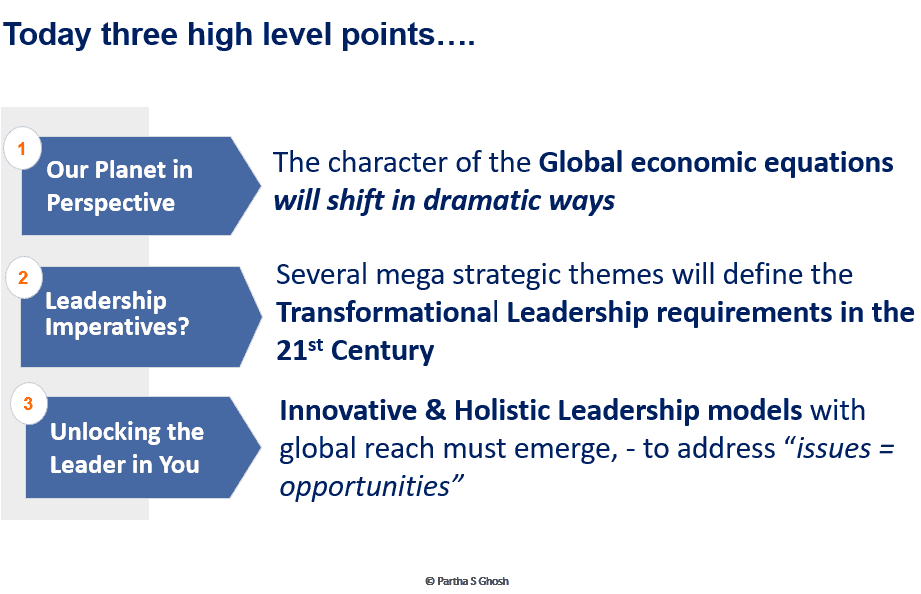
Universities have always been the fountainhead of new views, new thoughts, and new principles which have kept the world civilization moving in the right direction. I am confident, universities around the world particularly in the US, known for it’s ability to embrace emerging issues to evolve state-of-the-art cutting edge solutions, will continue to inspire its students to play significant roles. You are now sitting at historic cross-roads which I believe is great opportunity for all of us, particularly you as your fertile minds connect with the challenges of our time with an open mind. Accordingly, the presentation covers three fundamental points.
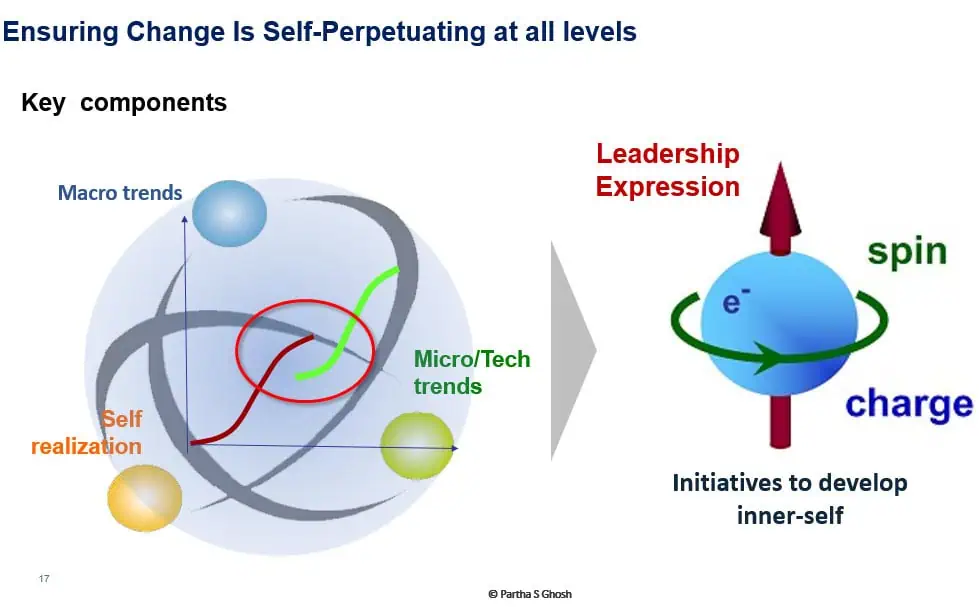
The time has come now, particularly for those who are graduating in this year and 2021 will now navigate through the next 12 months, which I term an era of COVID 19, to identify a role that is geared not toward short-term financial and/or “brand name” gains, but based on a more purposeful resolve to build “multi-dimensional trust” that today’s world is looking for. We need more charged Leadership Expression.
Leadership model to increase the Power to Influence
Leadership model to increase the Power to Influence
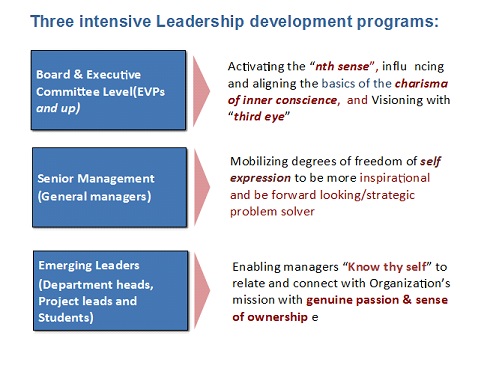
In order to help organizations develop their Leadership capacity, Partha Ghosh offers his clients three programs tailored for different levels of decision-making hierarchy
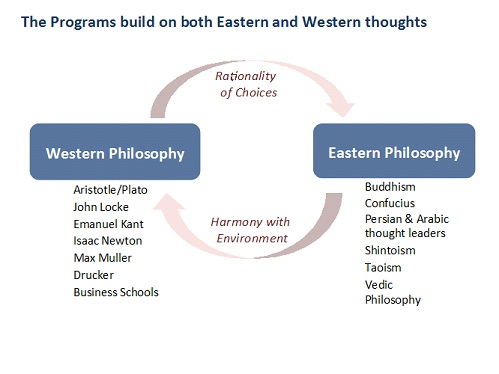
The programs essentially integrates Western and Eastern Philosophies
The programs essentially integrates Western and Eastern Philosophies
The programs essentially integrates Western and Eastern Philosophies
A few articles, presentations and white papers are available below:
A positive statement propels hope toward a better future, it builds up your faith and that of others, and it promotes change. – Jan Dargatz
Civilization at the Point of Inflection
Imagining a “Post Corona Virus” Global Economy – Prospects & Possibilities Ahead: Leadership Requirements?
As the spread of corona-virus continue to effect day to day lives of individuals in rich and poor communities world-wide, possibly never before in the history, we have experienced mega disruptions in the global socio-economic system in our thought processes, as they relate with politics, government, business, education, ecology and the individual in his/her social setting, – all at the same time, of magnitudes beyond normal comprehension.
When in January 25th this virus drew the attention of the world with the news that 1,354 were affected causing 41 deaths in Wuhan, the responses from government and business leaders at best were lukewarm, and many in an era of globalization chose to view the problem as local problem. Since then COVID 19 has spread rapidly in more than 170 nations, close to 500,000 people of lost their lives and more than 9.5 million are affected by the virus worldwide.
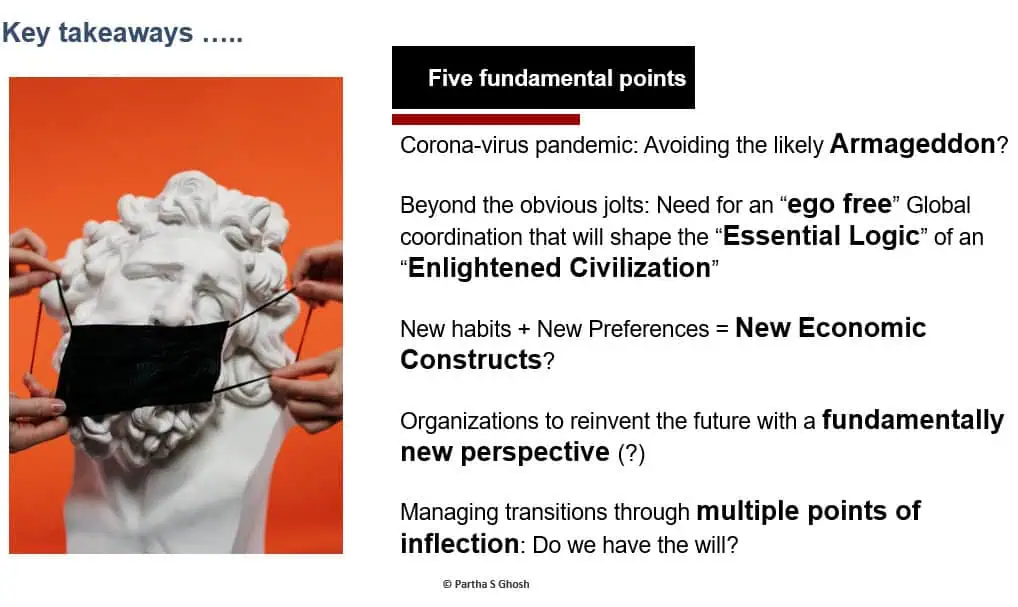
This phenomenon has clearly underscored that we as a civilization have once again failed to respond to “early warning” (however trivial, local or weak, a signal may look) seriously with proactive responses that such situations deserve. Accordingly, this presentation organized around five points, offers a strategic approach businesses and governments must adopt to genuinely address the potential Armageddon.
It is my hope as we engage with realities that COVID 19 has exposed us to, the current dynamic will perhaps inspire humanity to fundamentally re-engineer how human interactions will get transformed across a full range of socio-economic activities from education to healthcare systems, from agriculture to manufacturing and service industries – which could fundamentally redefine relationship between man and nature. I hope we have the will, and I know we have the skills(?).
Leadership model to increase the Power to Influence
Leadership model to increase the Power to Influence
In order to help organizations develop their Leadership capacity, Partha Ghosh offers his clients three programs tailored for different levels of decision-making hierarchy
The programs essentially integrates Western and Eastern Philosophies
The programs essentially integrates Western and Eastern Philosophies
The programs essentially integrates Western and Eastern Philosophies
A few articles, presentations and white papers are available below:
It has been said that arguing against globalization is like arguing against the laws of gravity.- Kofi Annan
Advancing the Promise of Humanity
It is indeed a special privilege and a great honor to have this distinctive opportunity to reflect on a gigantic personality like Rabindranath Tagore; that too at a kick-off event, which I hope will turn out to be an event to inspire, trigger, and support a series purposeful experiences and programs; – together the events must not only honor and celebrate the 150th anniversary of Tagore, but help to bring forward his thoughts and spirit at a time when the world is devoid of the kind of leadership our planet needs now. We need those leadership qualities that Tagore offered during the late later years of 19th century, and better part of the first half of the 20th century.
When I talk of leadership in the context of Tagore, I include all the possible dimensions of leadership – intellectual, spiritual, political, social that can transcend all types of borders – geographical, ideological, theological, cultural, social and professional.
Given where our civilization is today, it is indeed an opportunity time to reflect on his personality with an open mind and with highest level of reverence to his thought process expressed through his poems and his songs, his dialogues and his letters, his speeches and sketches, during his moments of sorrow and happiness, hope and despair.
Shri. Ghosh had the great advantage of being equally at home in the cultures of India, Japan and USA. This factor along with his sincerity no doubt, helped him to earn the respect of even Japanese CEOs – and that is not easy. – Arjun Asrani, Ex Ambassador of India in Japan
Partha Ghosh believes that in the evolving turbulent dynamics, future leaders must be able to inspire and influence outcomes not necessarily because of the titles that are handed to them, but on the basis of their inner power that will uphold the codes of conduct that are defined by the values and ethics, moral and civic sense that are fundamental to an organization and above all define strategic & operational problem solving spirit and performance benchmarks, which are truly competitive, – which people worldwide could trust, and benefit from at all the echelons of the organization.
Time has come when we should pause to understand the possibilities we are faced with and repurpose our “logic & ethics” of thinking, reexamine ways we structure and make choices so that we will be in a better harmony with the forces at work in the global economic environment. that It is Dr Ghosh’s strong conviction that society as a whole, “Need Higher Level Expression of Leadership” and such qualities need to be nurtured and developed early. In the next 5 to 10 years, particularly those industries that are at the epi-center of such a “historic phase shift” will require higher level of leadership expression to lead and respond to the changes at multiple levels of their decision-making and operational hierarchy.
Leaderships of organizations must realize that they have to manage two essential fronts to develop future leaders: (i) Content of what will constitute and define tomorrow’s leaders that will be very different from what defined their own leadership persona and (ii) Speed at which next generation of leaders (as a percent of total employees) that will need to be developed, has to be significantly accelerated.
Indeed, industry will need to think strategically with uncompromising long-term commitment in developing future leaders who could inspire imagination, accelerate innovation and adopt new management and organizational models, – that will allow them to embrace higher levels of complexity and technological risks, while facing increased competition and enhanced geo-economic and geo-political uncertainties, with grace & comfort,
Accordingly Dr. Ghosh believes that leaderships of organizations must dedicate significant amount of their time and corporate resources to cultivate a leadership culture to ensure everyone in an organization feel genuinely responsible for the domain of their influence – from the immediate areas of interest to widely accepted precept of protecting the natural environment and then extending the responsibility framework to include societal obligations as well, in the process making the organization a perfect expression of global citizenry.
In view of his extensive work with leaders in more than two dozen nations, Dr. Ghosh believes that in the emerging environment, for an executive to express and utilize his/her innate leadership qualities, the individual must go through a process of self-realization (Know thy self) in the context of his/her emerging work and decision-making environment, and the vision of the nature of leader he/she wishes to be, in becoming more effective.
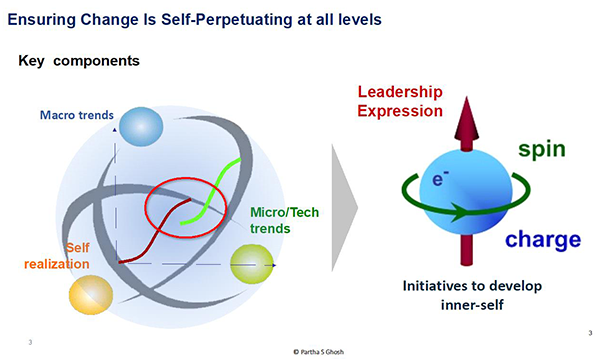
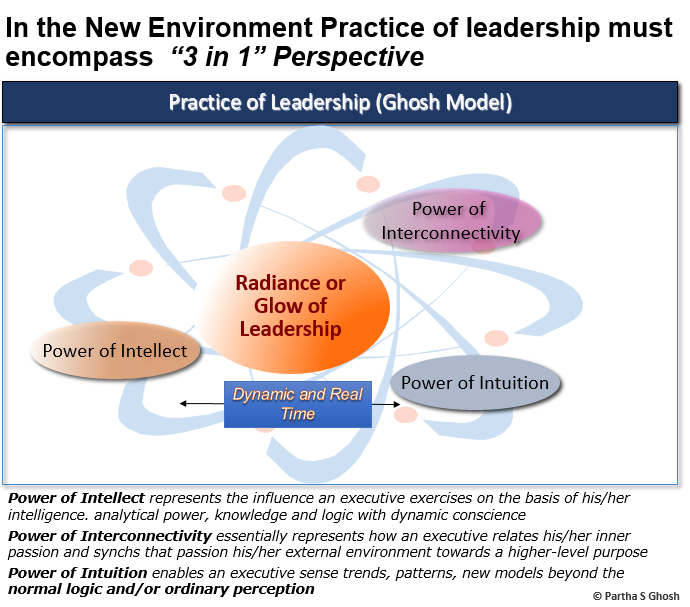
It is with a firm and unwavering conviction, Dr. Partha Ghosh expresses that at the most fundamental level an executive’s ability to influence outcomes is determined by how he/she naturally harmonizes three sources of “innate” power– (i) Power of Intellect (ii) Power of interconnectivity (iii) Power of intuition; in turn the basic model works toward cultivating in executive what he terms “radiance/glow of leadership”. When these three powers (as illustrated in the figure below) are fully synchronized toward a higher-level purpose in an executive’s work and decision-making environment, his/her leadership expression becomes natural, more visible, more trustworthy, in turn more inspiring and decisive in the domain of his/her influence.
Partha Ghosh Leadership model to increase the Power to Influence
It is important that senior management of companies, instead of just having leadership workshops focus on qualities such as visioning, decision making, communication etc., must first become conscious of how they could instill a leadership process that truly focuses on the development of the three powers within and then work on defining specific exercises (such as self-reflection, systems thinking, problem solving), which in turn lead to continuous development of those qualities that we revere in great leaders.
Indeed as the 3PIs are introduced in a well programed fashion organizations could sense: (i) how inner strengths and institutive capacity of the leaders could be expressed, and at “the limit” tested and measured (ii) how intellectual/thought leadership can make the difference in guiding problem solving process in uncovering transformational opportunities, and (iii) how interconnectivity can secure transparent and natural ways to establish “trust” based connections, internally between the different parts of an organization and externally with clients, suppliers, communities and governments, – with full range of stakeholders.
Dr. Ghosh believes that as organizations make uncompromising long-term commitment in developing future leaders who could innovate and adopt new management and organizational models, it will allow them to embrace higher levels of complexity and technological disruptions/risks while dealing with increased competition and enhanced geo-economic and geo-political uncertainties – in achieving superior results.
In this spirit, Partha Ghosh helps leaderships of organizations manage three essential fronts: (i) Articulating the content of what will constitute and define tomorrow’s leaders (ii) Conducting leadership workshops/retreats to accelerate the development of leaders and (iii) Mentoring and coaching executives to help them express desired leadership behaviors.
A few articles, presentations and white papers are available below:
I have not failed, I’ve just found 10,000 ways that won’t work.- Thomas Alva Edison
Innovation
The triumphs of human endeavor of the last quarter century are indeed significant. The power of technology from intelligent handheld devices, high-speed wireless Internet, bioinformatics, nano and opto technologies to large scale engineering systems deployment in deep seas to hypersonic air and space travel, – in resonance with each other have opened up new frontiers of human imagination. If properly cultivated and purposed we will for the first time in history harness those hidden powers of nature, which could spread innovative solutions and well-being across all nations.
It is important to realize that unlike the previous technological discontinuities triggered by the steam engine and the internal combustion engine which essentially helped mankind to go beyond physical limits of humans there-by change the meaning of space, mass, and time, the developments of the last 25 years today enable us to leverage the power of mind, the power of human spirit, a power which in an ideal world is infinite.
In order to face these challenges and explore new possibilities, we need new approaches, new ways of relating with nature and each other, that will enhance innovative capacity of society and allow us to leverage the power of emerging technologies in ways that will make future progress more equitable, sustainable and peaceful.
Dr. Ghosh argues that leaderships of organizations will need to frequently readjust thier lens as to how they view the problems and possibilities at all levels of thinking/decision making hierarchy, – Philosophical, Strategic and Operational, in turn how we unleash the “power of innovation” to uncover the new rules of engagement with nature and each other.
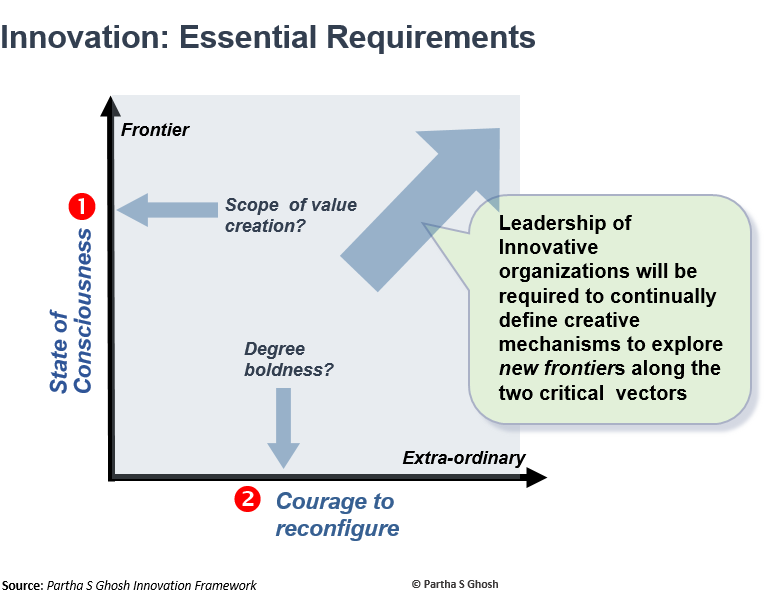
The Power of Innovation in my view is a product of two fundamental vectors (Exhibit below):
Perspective or Conscience with which we view the possibilities andCourage & Creativity with which we break/reform the rules to realize new possibilities.
Industry will need to learn how to reconfigure the conventional processes with new technologies with a higher-level purpose, while developing more robust systems capabilities with a holistic perspective to tap into earth’s resources in a more responsible and sustainable fashion.
In view of the complexity of the challenges ahead organization will be required to renew strategic discipline for the management of innovation that could drive the convergence of multiple disciplines of thinking to create “innovation led“ growth paths which are profitable, perpetual and sustainable.
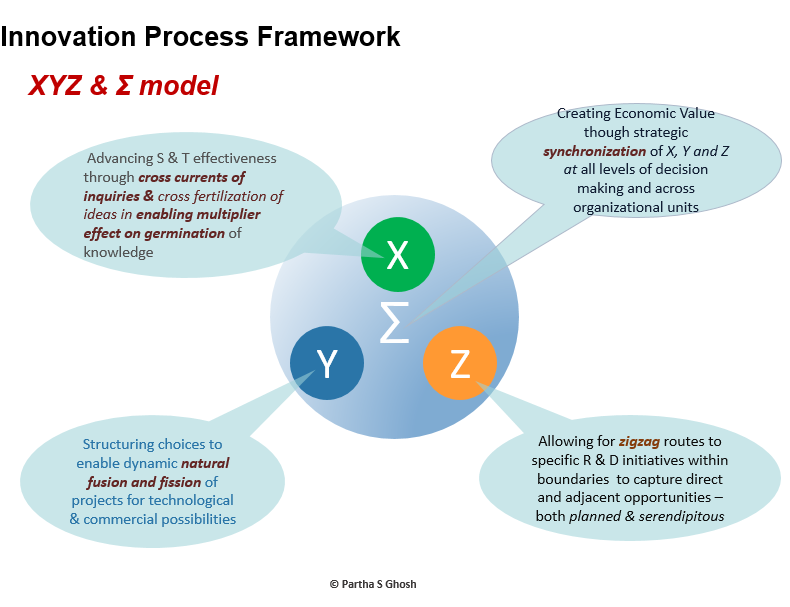
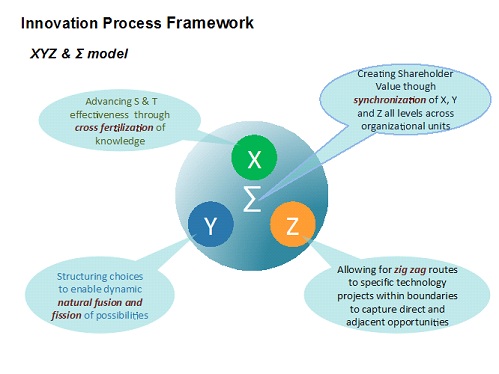
Partha Ghosh’s work with organizations around the world, across dozen industries suggest that “Innovation can only be inspired and maximized when senior leaders commit to the creation of a self-reinforcing culture”. A truly innovative culture is a function of four components, which he terms X, Y, Z and ? (Exhibit below), – which together shape organization’s culture and discipline of innovation and the dynamics of technology management at multiple levels of decision making, – including definition of corporate technology strategy, management of technology portfolio and guidance/execution of specific technology initiatives.
XYZ? Model Overview
Companies across industries are indeed faced with an historic opportunity to renew their approaches to access frontier technologies, while uncovering new technologies. Who will win in the future, will be determined by how companies embrace new innovation and technology management processes, and cultivate cultural attributes that will celebrate (i) cross flows of ideas and IP ( X) (ii) real-time structuring and restructuring of projects (Y) for ensuring R &D/project portfolio are dynamic, (iii) zig zag and resilient development(Z) of specific projects within strategic boundaries to reach specific targets while not loosing serendipitous opportunities in adjacent areas (iv) continue harmonization(?) of XY and Z to create the intellectual and creative ferment all across to continually nurture an innovation ecosystem.
Partha S Ghosh works in partnership with client teams to design, develop and deploy formal and informal processes – a few loose and few tight, to instill XYZ and ? to cultivate sustainable, self-reinforcing and self-enriching innovation culture.
A few articles, presentations and white papers are available below :
It has been said that arguing against globalization is like arguing against the laws of gravity.- Kofi Annan
Globalization
Triggered by powerful events since the beginning of the 20th century, the changes that are taking place in the global economic landscape are indeed significant, – profoundly changing the process and the dynamic between factors that are influencing the globalization process. Equally significant will be the nature of changes businesses and governments will need to undertake to serve the emerging opportunities, and to offset the rising tensions.
On one hand the new dynamic will create a new wave of middle-class consumers, and drive profound innovations in product design, market mechanisms, and value delivery processes, but on the other hand spread of global terrorism, internet hacking will increasingly haunt and hamper the trust and goodwill between people across societies and nations.
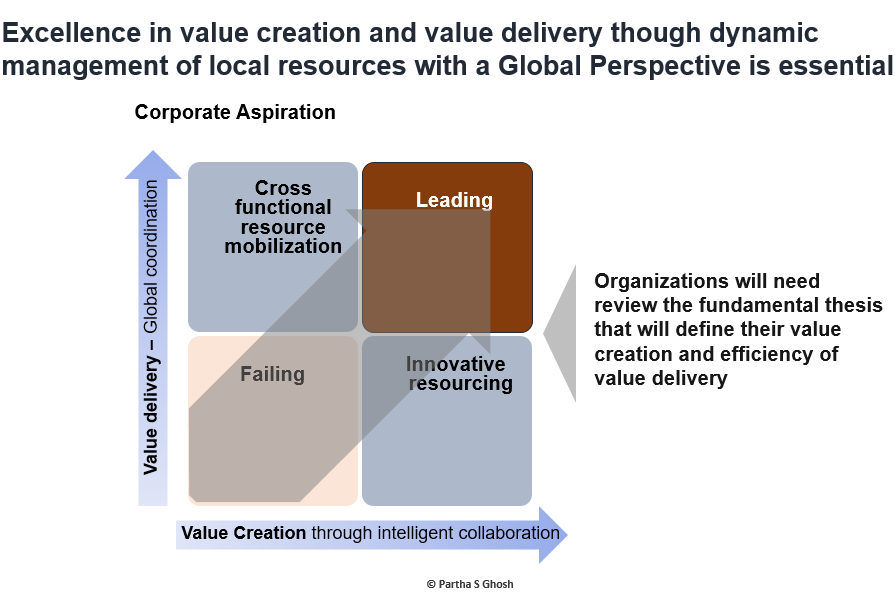
The often contradictory demands of driving growth and providing safety to maintain social and political stability will put governments under profound pressures which businesses, global and/or local have to be increasingly sensitive to. Partha Ghosh hopes that these new requirements will lead to invention of new models of collaboration for both value creation and value delivery between businesses and governments at both local and global levels, – which progressive organizations must actively seek. The exhibit below captures how both value creation and value delivery process have to be dynamically orchestrated transcending interests of a few, to serve the wider interests of multiple stake holders.
Particularly as the world shrinks and get exposed to higher level of economic and political turbulences, the resulting interactions between different human tendencies and inclinations will have profound impact on interpersonal relationships and ways companies do business across the globe. Significantly more softer elements of leadership will be important: – the values and beliefs of the corporation have to be strongly embedded in the decision making architecture of the Global enterprise so that mangers closer to where competitive games are played are fully empowered to be able to make quick and informed decisions.
In order to help leaderships of multinational businesses navigate through the evolving turbulence, Partha Ghosh through:
Tailored executive development programs help a Global Company’s country heads to step up their roles along multiple dimensions; so that the future businesses are viewed as truly trusted partners by the various stakeholders in the local environment—customers, local and central governments, NGOs, local and national education systems, —while they enable global coordination of Global assets – hard and soft, technologies – elemental and systems, and corporate goodwill within a full range of stake holders worldwide.Brainstorming sessions help leadership of organizations think through geopolitical geo economic scenarios to design and structure strategic options and collaborative processes, – so that the level of readiness and degree of agility to execute “winning moves” are significantly enhanced.
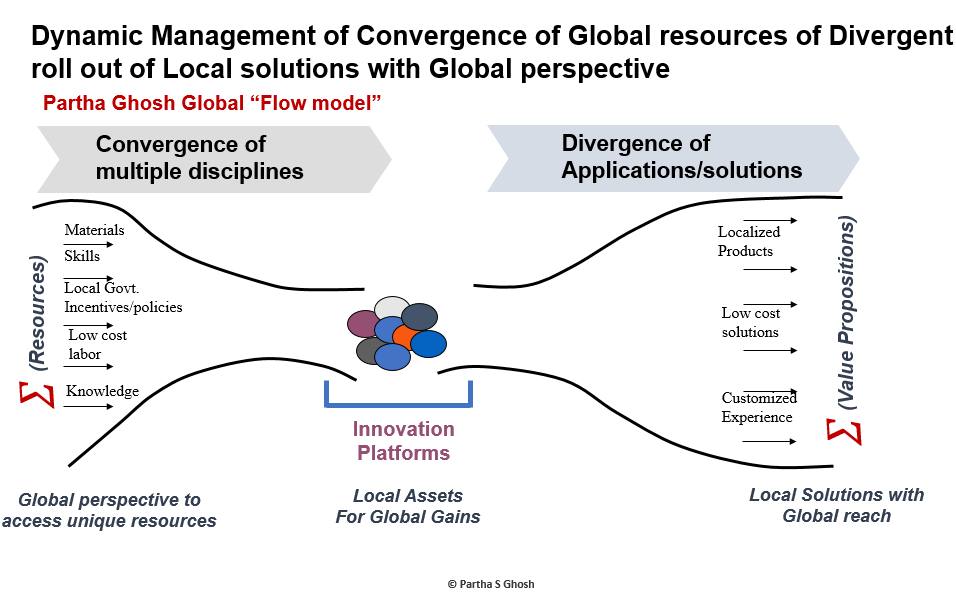
Organizations must embrace a variety of business and organizational models that are each adaptive towards each other and, as whole, adaptive to emerging global challenges. Ghosh believes that forward looking global businesses will continually need to learn how to navigate through complex global and local forces to define innovative mechanisms to create sustainable competitive advantage in “organization IQ”. Through involved workshops to evolve “next phase Globalization process”, Dr. Ghosh helps organizations adopt what he calls the “Global Flow” model. (Exhibit below)
The “flow model” as the name signifies, views the global enterprise as a “flow process” which continually harnesses unique resources from different regions (in harmony with local expectations) of the world, manages the convergence of the relevant resources on global innovation platform to continually create a diverging range of value propositions tailored for local environments. Such a flow process will enable on one hand global division and development of labor, and on other hand enable conservation and expansion of knowledge at both local and global level. In the process in the next phase of globalization organizations will enable global orchestration of hybrid (Global and local) supply chains. Dr. Ghosh through workshops in multiple locations of the global enterprise hopes to create the next model of the Global enterprise with more emphasis interconnectedness of thoughts and transcendence.
Most importantly, in order to achieve such a dynamic state, businesses will need to develop innovative mechanisms to cultivate leaders with wider skill sets and “behavioral and attitudinal” resiliency both at the field and at the headquarter levels, while ensuring that organizational capabilities in terms of sensing, processing and pursing opportunities at different levels of integration and differentiation are continually renewed and are sensitive to the complex and turbulent geopolitical instincts.
Tact is the knack of making a point without making an enemy.- Isaac Newton
Strategic Scenarios and Options
Scenarios & Strategy Options = Being open to ”new perspectives with “expanded options”
History shows that it is during times of “mega-transition” and/or discontinuities that new ideas are born and new rules take root. As partners of our clients, we continually examine how leaderships of organizations should find the bright spots that are often hidden in turbulent competitive landscape(s) and in turn define the likely game changing plays that they could organize in moving forward.
Partha Ghosh believes that seven emerging trends will have profound impact on how industry leaders shape their strategies, develop their organizations and run their operations.
Convergence of technologies, especially tera-level to nano level technologies, will create new economic ecosystems: Fresh perspectives on how new possibilities might evolve at the confluence of tera-level to nano level technologies will be essential.Influence of Big Data and Advanced Analytics will define competitive advantage: Velocity of value creation and speed of responsiveness based on granular/high resolution insights will define competitive advantage.Intensifying concerns and advocacies on relating to global warming and resource constraints: Efficiency of resource mobilization in harmony with the diverse, often opposing expectations of a full range of stakeholders, to proactively ensure that the integrity of the environment is increasingly preserved.Y-Generation and “value mobilization” of knowledge workers: Because of widening divides between the attitudes toward the workplace, cross-generational organizational models will be need to be nurtured to integrate multiple tiers of attitudes and expectations towards a common purpose.Deepening influence of social media on the evolving networked environment: Leading (distinct from managing) in a world connected through social media will require higher level expression of genuine & dynamic empathy, transparency & ethics of thought and work flows, through innovation in leadership development models.Shift in geo-economic equations between regions: New modes of engagement with different regions will require approaches tailored towards local communities, bound within a multifaceted, universally accepted global framework that sets out the precepts of good corporate citizenship.Rising tensions between Wall street (wealth creation) and Main street (social good): New operational models will evolve that dynamically integrate (not just balance) social consciousness/macroeconomic requirements with the investment community’s growing demands for better economic returns – perhaps charting a new course in the evolution of capitalism.
The emerging trends will require leaderships of businesses to make transformational adjustments so that their business models do not get disrupted, if not renewed with higher level of aspiration to capture the significant value creation possibilities on the upside. It is not too difficult to sense how profound transformational impact all of them together might have on the future business environment worldwide. Companies must work towards defining the “essential logic” that should help them to harness the power of the seven trends in harmony with each other.
Leaderships have to find ways to explore frontier trends by developing and fusing new skill sets with conventional wisdom that they have earned over decades of experience, – to drive the next era advancement of the industry they are in. Given the likely scale of impact and the degree of strategic and operational orchestration and cultural change that will be required, active engagement from the CEO and senior leaders is essential.
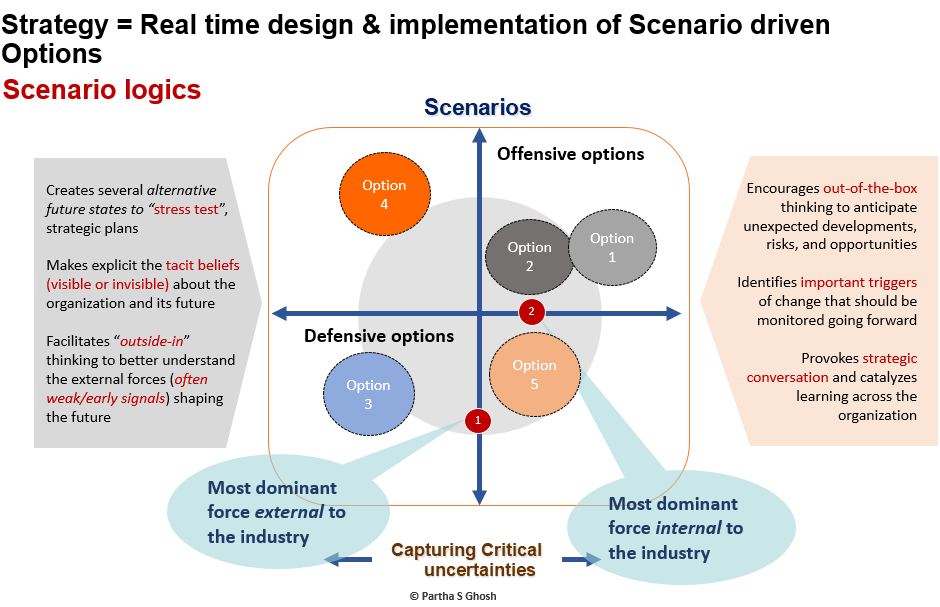
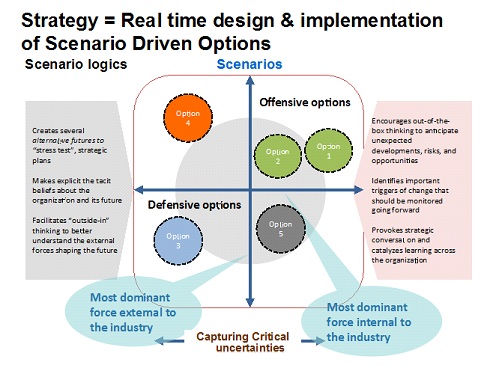
It is Partha Ghosh’s firm conviction to break old habits and to realize the value of flexibility in today’s dynamic environment, strategic management process must capture possibilities and probabilities with a rigorous analytical discipline, deploy new ways to guide the management with options/choices, and accelerate decision-making process. Exhibit below provides a view of the framework Dr. Ghosh uses in serving leaderships of organizations.
In view of his years of strategic problem solving experience across more than dozne global industries, Dr. Ghosh believes that a “Dynamic Strategic Management” must be a symbiosis of “art of imagination” and the science of “systems oriented thinking”, based on deep analytical rigor. Senior management of companies will have to find imaginative ways of sketching out game-changing possibilities by realizing that “Cross Boundary Solutions” will continually emerge to break the constructs of conventional industries. As businesses undertake mega-capital projects and attempt to take advantage of the convergence of technologies from different domains, companies will have to work with multiple tiers of vendors and service providers – just as companies such as Boeing and Toyota have worked with numerous suppliers in the aerospace and automotive industries, as does Apple and Spcae-X.
These relationships will depend on the nature of the assets being developed and their particular technological requirements – from nano/micro level technologies, such as micro sensors, to tera-level technologies, such as satellite-based communication systems. Not only will relationships be different for different assets, but they could evolve over the lifecycle of a particular asset, adding new members, for example. As in the movie industry, project leaders across industries must increasingly be able to bring together different actors with wide-ranging skill sets to extract value from specific assets.
Accordingly, businesses must also be prepared to adapt and modify the form of cooperation and collaboration as projects matures. Organizations will need to develop the leadership capacity to construct, deconstruct and reconstruct cross-industry ecosystems quickly, which often in a hierarchical command and control organization construct difficult to achieve.
Partha Ghosh believes today in view of increasing uncertainties leadership of organizations must have access to wider set of options to make and as required rebalance strategic bets. Accordingly, Dr. Ghosh continually underscores that the role of strategic management process is not to predict the future and eliminate the management’s fear of the unknown by documenting the strategic direction that has already been set. The role of strategic management process is to (i)provide analytically sound understanding of the dynamics of the competitive market place (ii) offer set of strategic options (for different scenarios) that (iii) guide management to structure and make hard decisions and place intelligent bets.
A few articles, presentations and white papers are available below:
Based upon his great knowledge of macro and micro economics, he has deep insight on Japanese enterprise. His creative and strategic thinking to solve complex corporate problems generates innovative and unique plans for our Board of Directors.
Accordingly, Strategic Management to be relevant it has evolve as a symbiosis of “art of imagination” and the science of “systems oriented thinking”. Senior management of companies will have to find imaginative ways of sketching out game-changing possibilities by realizing that “cross boundary solutions” will continually emerge, – to break the constructs of conventional industries. As businesses undertake mega-capital projects and attempt to take advantage of the convergence of technologies from different domains, companies will have to work with multiple tiers of vendors and service providers – just as companies such as Boeing and Toyota work with numerous suppliers in the aerospace and automotive industries.
These relationships will depend on the nature of the assets being developed and their particular technological requirements – from nano/micro level technologies, such as micro sensors, to tera-level technologies, such as satellite-based communication systems. Not only will relationships be different for different assets, but they could evolve over the lifecycle of a particular asset, for example adding new members, while retiring old members. As in the movie industry, project leaders across industries must increasingly be able to bring together different actors with wide-ranging skill-sets to create and/or extract value from specific assets.
Businesses must also be prepared to adapt and modify the form of cooperation and collaboration as projects matures. Organizations will need to develop the leadership capacity to construct, deconstruct and reconstruct cross-industry ecosystems quickly, which often in a hierarchical command and control organizational architecture difficult to achieve.
In summary, today in view of increasing uncertainties, leadership of organizations must have access to wider set of options to make and as required, rebalance strategic bets. It is important to underscore that the role of strategic management process is not to predict the future and eliminate the management’s fear of the unknown . The role of strategic management process is to provide analytically sound understanding of the dynamics of the competitive market place and guide management to structure and make hard decisions and place “high reward high risk” bets.
A few articles, presentations and white papers are available below:
To improve is to change, to be perfect is to change often.- Winston Churchill
Organization
In a high frequency competitive socio economic environment, at the heart of any organization’s performance will be its leadership’s ability to commit to evolving a set of cultural attributes, which will define its ability to continually renew itself to stay in tune with, if not stay ahead of the changing industry landscape. In order to attain such a state it will require organizations to (not comprehensive) adopt and continually refine five key functions:
High speed sensing and learning function: In an accelerating knowledge intensive environment, which is vulnerable to sudden disruptions, an important function an organization must continually develop is its ability to sense and learn from the emerging trends; in large extent increasingly an organization’s capacity to win competitive games will be determined by how sharper and smarter is this function relative to its competitors. In turn corporate leaderships should aspire to cultivate a culture of intellectual ferment that is enduring and self-energizing, and truly celebrates “the spirit of inquiry” and cultivate the courage for “imaginative leaps”.Integration function: Organizational mechanisms, both formal and informal, that enable cross-pollination and/or cross fertilization of new trends/thought streams in turn enable germination of ideas within an organization, across business units and the corporate center, to enhance an organization’s ability to drive new advances, will need to established. Integration mechanisms should also facilitate collaboration with the innovation centers external to the enterprise such as technology vendors, partners and academia/national labs.Distributed leadership function: An organization’s ability to develop and empower executives to make bold decisions (based on analytical rigor) and to inspire teams close to day to day operations, will determine how it speedily responds to rapidly evolving opportunities and/or competitive threats. CEOs must pay considerable attention to cultivating a leadership culture that (i) ensures everyone in the company feels genuinely responsible for their domain of influence – from immediate areas of interest to the widely accepted precepts of protecting the natural environment and meeting social obligations, (ii) engenders a high degree of commitment to performance, so that every one across the value chain at all levels of the organizational hierarchy naturally manage their individual and collective performance with a Kaizen spirit (continuous improvement) – to continually seek higher levels (benchmarks) of productivity of assets and resources (hard and soft) worldwide, (iii) goes beyond incremental improvements and searches for and implements big game-changing shifts with the potential to revolutionize the industry.Activist function: It represents a discipline that will provide an organization with the ability to challenge status quo and move out of comfort zones to find new sweet spots. This function must help executives challenge current value creation thesis and business model in structuring new choices accordingly organize myriad of ideas/conceptual breakthroughs into discrete, new and meaningful innovation platforms. Executives responsible for such a function should, as a matter of course, assess outcomes from a range of experimental perspectives, while ensuring that specific micro and/or mega forces that are triggering and driving the trends in the environment are continually examined in relation to current business model.Adaptive function: This function must be embedded in organizational units so that both corporate center and business units have the flexibility to make rapid organizational adjustments in terms how resources are mobilized and how the reporting lines are rewired; so that when required a company has the ability to switch from one game plan to another game plan in navigating through an increasingly turbulent competitive environment. Particularly in those industries where rapid convergence of technologies are increasing the likelihood of unforeseen outcomes leading to sudden disruptions, the adaptive function must keep the innovation process alive, in turn often serendipitously expand the possibility of specific outcomes.
Partha Ghosh believes that leadership of companies must examine alternative ways organizations could develop a multiplicity of cultural attributes which will together determine an organization’s ability to regenerate itself. In the process leaders could seed and nurture new possibilities, while developing the capacity to evaluate uncertainties to cultivate the courage, not to avoid but navigate through risks.
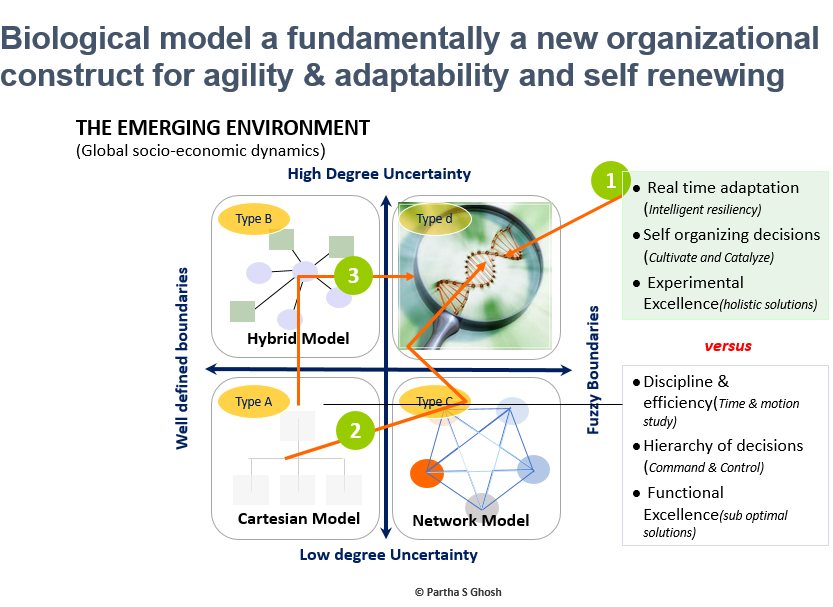
Accordingly, Dr. Ghosh underscores that for organizations to achieve their full potential they will need to shift from a mechanistic command-and-control model to a self-enriching, adaptive biological model (Exhibit below). This would improve the management of knowledge as enabled through organizations’ learning, information processing and knowledge (creating, sharing and filtering) management capacities and capabilities. Each process is self-enriching when managed correctly, and self-consuming when managed poorly. It is important the CEOs and their leadership teams, help their immediate environment invent new organizational mechanisms which “involve and inspire”, are “knowledge enriching” centric, and not “command & control” and/or “ego”-centric”.
Future Organization: Orchestra of dynamic functionalities/skills
In order to make the biological model with the critical functions of the future become active, organizations will need to sync two fundamentally different initiatives:
Short-term “quick win” initiatives: to do more with less, and reconfigure and improve value propositions from the past for future use.tLonger-term “change” initiatives that will enable the development of new pathways to value capture/creation and economic advance.
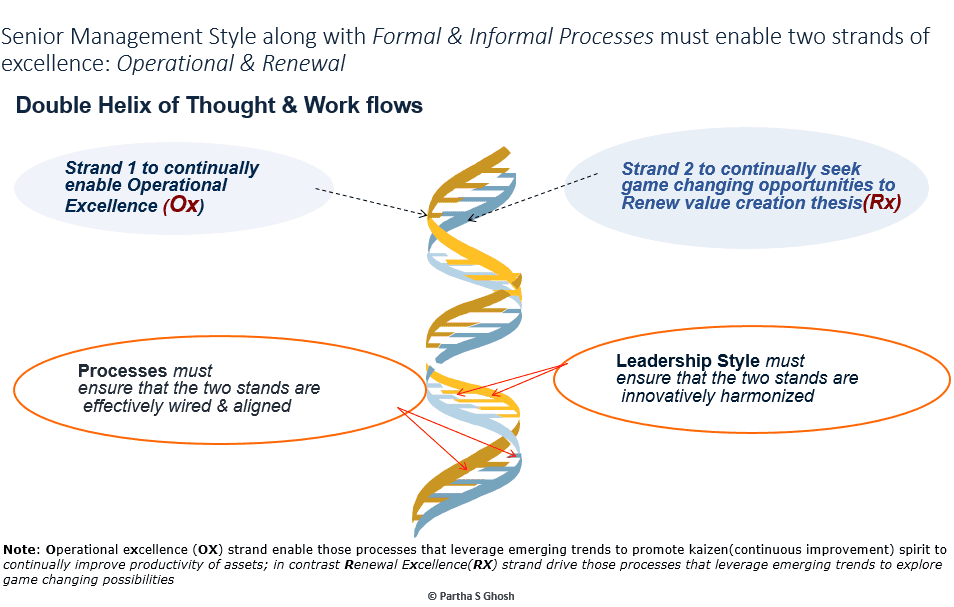
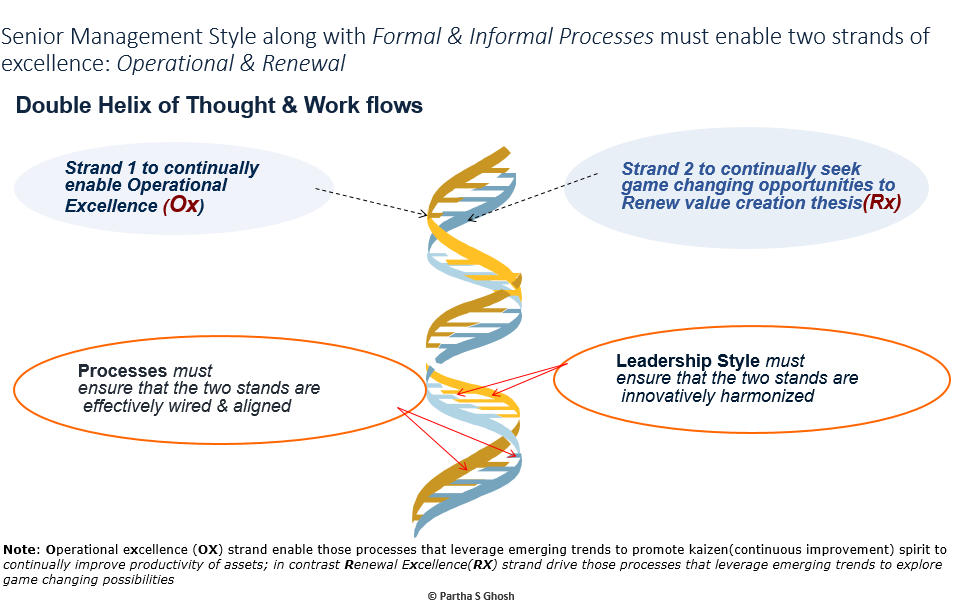
The “Double Helix” organizational construct (Exhibit below) will enable the evolution of two kinds of independent thought-flows and workflows. The strand 1 shows how the five functions can be best configured to achieve Operational Excellence (OX) for current business models. The strand 2 focuses on Renewal Excellence (RX) to leverage the same five functions to pursue transformational game changing opportunities.
Double Helix Organizational Construct
What is important is that leadership of organizations on one hand support the independent development of both strands to the fullest extent, while on the other hand ensure that there is smoothness and a natural rhythm in the working dynamics between the two.
Parallel to the day-to-day initiatives aimed at achieving performance excellence, companies must develop a culture that makes sense of and engages with creative, un-tested opportunities ahead of their strongest rivals. Corporate leaderships have to find ways to explore the frontier trends by developing and fusing new skill sets with conventional wisdom that they have earned over decades of experience, – to drive the next era advancement of the industry. There are no best practices for nurturing innovation; the CEO must create an environment that will cultivate internal structures, processes and leadership styles suitable for this purpose – and make the double-helix organizational processes a reality.
Partha S Ghosh works with leaders of businesses to develop biological organizational models that are more adaptive to changing environment, and more creative to drive innovation. In order to do so he believes leaderships of businesses – large or small have to renew the vocabulary of organization design for various factors, as shown in the exhibit below.
Most importantly, in order to achieve such a dynamic state, organizations will need to develop innovative mechanisms to cultivate leaders with wider skill sets and “behavioral and attitudinal” resiliency both at the field and at the headquarter levels, while ensuring that organizational capabilities in terms of sensing, processing and pursing opportunities at different levels of integration and differentiation are continually renewed and are sensitive to the complex geopolitical instincts.
A few articles, presentations and white papers are available below:
Spiritual development is paramount for internal strength & character of the individual. Material pleasures and achievements come second.- Chanakya
Economics & Philosophy
In an era of knowledge explosion, we should have increasing opportunities to advance the socioeconomic promise of our civilization. It is only natural to expect that it should be relatively easier now to spread the “enthusiasm of learning” in creating “opportunities of economic growth”, and in helping organizations—corporate and government across communities and nations, to be wiser in their resolve and more genuine in their actions.
However, the unfortunate developments in the past several decades at both at the macro and micro levels, paint a different picture. At regular intervals we have experienced sudden economic jolts, – such as the sub-prime mortgage meltdown, the collapse of Enron, WorldCom and Shearson Lehman to name a few, followed by a major financial crisis in 2008, while the gap between rich and poor worldwide most importantly have continued to widen.
Every year conferences such as the one in Davos and the Clinton Global Initiative in New York bring together world leaders from different facets of life; yet the discussions appear to be increasingly “in reaction to” as opposed to being “proactive or predictive”. In the process for the larger segment of the global community the discussions in such leadership forums seem to be irrelevant, as the nobler motives get continually overshadowed with more powerful destructive forces – forces that are products of human selfishness, undisciplined and corrupted ethics of decisions, and above all greed for power and wealth.
The trust people place on leaders from academia, business and government, has been compromised. Perhaps we need to examine and rethink the measures of success that leaders value, – which today are highly limited by economic equations of the past, and constrained by lower level human instincts. It is especially true if decisions are made purely on the basis of individual greed and/or short sightedness to secure quick applause, these decisions permanently scars the “trust” and “integrity” on which modern economic systems have been built.
Individuals in leadership roles must realize that their power to influence great deeds and great thoughts in society is significantly more (in orders of magnitude) than they imagine. Our difficulties as human beings to make the right judgment calls are being limited by two fundamental factors:
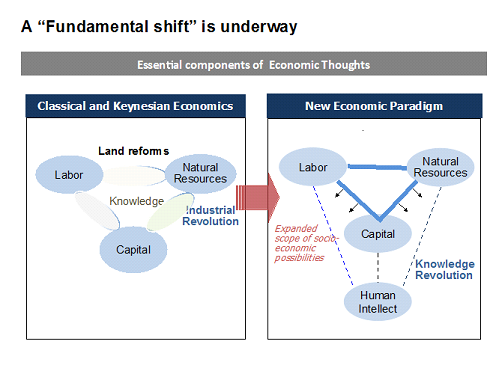
Much of economic thinking of the past 250 years since the days of Adam Smith was influenced, and in turn constrained by laws of physical sciences. These laws imply that peoples’ responses to economic incentives or penalties will be rational and similar, – irrespective of their intellectual and cultural differences in defining the dynamics of equilibriums between supply side and demand side equations. Unfortunately, choices people often make are neither rational, nor based on same set of cultural/ethical factors.Furthermore, the world economy has been in a “state of transition”, influenced by the development of the knowledge based industries and the challenges of harmonizing “tera level” global imbalances in energy, ecology and equity. As the new state is evolving, the relevance of doctrines of economic thoughts that emerged in very different environments (such as the first and second industrial revolutions) becomes further limited. We have reached a point in history when global economic realities have out-grown the economic laws that we have developed and debated over the past two centuries.
No wonder, we see all around us today a rapid erosion of confidence in economic thoughts from the past. At a macroeconomic level, policy makers worldwide seem not to have the conviction that is required to make decisions and take actions that benefits all people– which offer equitable economic opportunities. Not surprisingly, in economically privileged regions of the world the youth of today are disheartened, adults are confused and faced with justifying errors of judgments, while one third of the global population is struggling to keep their hopes alive fueled by $2/day of resources.
The breakdown of the Soviet Union in the early nineties and the occupy Wall Street movement in 2007/2008, only underscore the limits of the two “isms” – Capitalism and Socialism, economists have debated since the days of Karl Marx.
Accordingly both on the supply and demand side of economic equations we need to change. Change we me must, not only for the short term by consuming less and/or by demanding more efficiency of what we use today, but also for the long term by inventing and putting in place processes that could fundamentally reconstitute our production and consumption instincts. Such changes cannot happen by simple linear extension of the current ways of being and economic thinking into the future; we must first envision a future with a zero base mind set, with eco-neutral resolve, and then work back from that vision to define the issues we must address today.
We must vigorously rethink what constitutes the “Arts & Science of Economics” with as much vigor as physicists and chemists continually challenged earlier laws to develop deeper understanding of the forces of nature.
Particularly when it comes to the discipline of Economics, we must realize that the interactions between individuals, between societies, between nations are significantly more complex and are in a continuous state of flux. These interactions, – sometimes rational often irrational, are influenced by the relative differences in ethics, education and experience of all of their participants. As much as Einstein and Plank changed our thoughts in physics, and Bose changed our understanding of what defines the fundamental particle, perhaps the time has come when the discipline of Economics need to be reimagined with a wider and deeper perspective on the nature of humans, and way the choices are structured and made, individually and collectively, not only for self preservation or to serve self interest, -but also for the advancement of social conscience.
Partha has an unusually imaginative and creative mind and has contributed a lot to the thinking about the Asia Pacific region. – Jim Kennan, Deputy Premier, Queensland, Australia
Moving forward in making the discipline of economics more relevant for the future of civilization, to serve those who are marginalized as well as those who are in the center stage, businesses and governments have to pay attention to several fundamentals:
1. The “power of human intellect and knowledge” will increasingly emerge as the most powerful influence in defining the architecture of the new economic equations. In particular, as shown in the exhibit below “Human intellect” as an independent component will influence the deployment of capital, natural resources, and labor, in expanding the economic possibilities across nations.
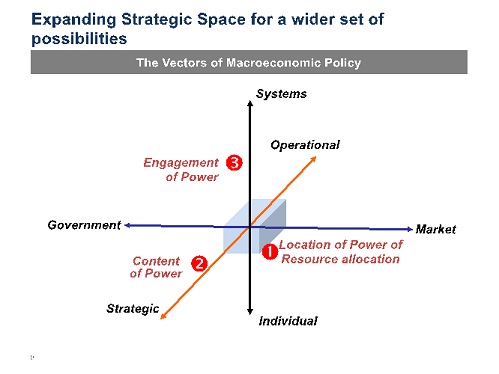
2. At macroeconomic level, economists as a result, instead of just debating along one vector – where the power resource allocation should be located, – government or market (?), as shown in the exhibit below, they should also include two more vectors for expanding the scope of policies that could be more effective in facilitating socio-economic gains: – (i) What should be the content of the power – strategic versus operational (?), and (ii) How should the power engage (in terms of incentives and regulations) with people and with systems/institutions in the economy(?).
3. In the same spirit as shown in the exhibit below, at micro-economic level businesses have to engage with the 21st century economy, in ways that are fundamentally different from the past.
The world economy has indeed been in a state of a major transition. Current thinking in economic disciplines has difficulty measuring up to how individuals relate with each other, individuals relate with society, societies relate with each other, and above all how human relate with nature. At multiple levels, – macroeconomic, industrial and individual, as shown in the exhibit below the fundamental doctrines that have defined the “essential constructs” of our thought process need to be re-examined for a robust advancement of civilization.
Too often because of the lack of understanding of the nature of constraints that suffocate our thinking, the leadership of organizations thought processes and decisions are shaped by the constructs of the past. In turn we fail to relate with the mega-shifts and we appear feeble in coming to terms with “course correction” that advancement of civilization requires. The Arts & Science of Economics will need to integrate lessons from three streams of thought processes: (i) physical sciences to define cause-effect relationships (ii) Behavioral/Psychological discipline to understand how social intelligence is formed in various cultures and in turn helps or hurts progress and (iii) philosophy to reflect on how codes of ethics and reasoning, morality and integrity influence socio-economics outcomes.
I found Partha to be an innovative, forward looking thinker with a deep-rooted desire to make a positive impact on the task at hand. He brings a unique perspective to issues, a result of the diverse work that he has undertaken across the Globe. – Mr. Ratan Tata, Chairman of the Tata Group
The current global economic uncertainties in the midst of accelerating imbalances in the 3Es, – Energy, Ecology and Equity while unwelcome, indeed offers an opportune time for us to step back and explore how the fundamental backbone of the interconnected global economy could be reinvented, and how our basic conscience that drives our consumption and resource allocation behavior could be reshaped and repurposed.
This reinvention of the future must help humanity to facilitate a new relationship between human and nature, which is not extractive but enriching, which is not consumption centric but conservation centric. In the process social and economic structures will need to be reconfigured so that resource allocation processes will become more distributed and decentralized and the value addition model could move from being linear to circular, possibly giving birth to new form of capitalism which I call “cellular capitalism”.
I was greatly impressed by the way Partha combined his vast experience and knowledge about the macro, sectoral and micro levels of issues with his superior analytical ability. Another of his outstanding attributes is his ability to build strong relationships and lines of communication with representatives of diverse segments of civil society. – Bülent Eczac?ba??, Chairman, Eczac?ba?? Group
Only, such an approach will give birth to a full range of new concepts of community, education, governance, health care, industry and work, which will open up new wealth creation and employment possibilities that could not only offset the ill effects of the meltdown (economic and environmental) but create new growth pathways to draw significantly more people from under privileged economic backgrounds into the global market place.
Now we need bigger ambition beyond our own requirements. We must cultivate the inner courage and conscience to inspire individuals, organizations and societies to perform beyond the ordinary in strengthening the basic fabric of humanity..Nobler motives should be our strongest motives. As more commodities are produced each individual must not become commoditized but instead valued for his/her inner charm. Let this new “Art and Science of Economics” lead us to toward a world beyond capitalism and socialism, as we know them, which over the past ten-to fifteen years, I have been calling “cellularism” or “x” ism?
A few articles, presentations and white papers are available below: